Winery Email Seasonality by Region
The holiday peak in winery email is a California and Oregon pattern, not a universal one. In Napa Valley, December volume runs 64% above an average month. In Sonoma County it runs 88% above. In Texas Hill Country, December is 13% above average, and February is busier.
At a glance
- Across all regions, December is the busiest month (index 147) and January the quietest (74).
- Napa, Sonoma, the rest of California and Oregon peak hard in November and December, at 138 to 188.
- Texas Hill Country is the flattest region. Its holiday months sit at 109 to 113.
- Niagara peaks in June, July and November, not December.
How does the year look across all regions?
Each number below is an index where 100 is an average month. A value of 147 means 47% more email than that region’s monthly average.
| Apr | May | Jun | Jul | Aug | Sep | Oct | Nov | Dec | Jan | Feb | Mar |
|---|---|---|---|---|---|---|---|---|---|---|---|
| 101 | 107 | 90 | 89 | 88 | 83 | 108 | 135 | 147 | 74 | 84 | 94 |
This covers April 2025 to March 2026, from 207 wineries and 8,240 emails. Only wineries we followed for the whole 12 months are counted. That matters: Joy Cork added about 120 wineries in early 2025, and counting them would make the months after they joined look busier than they were.
A second group, 87 wineries followed for all of calendar 2025, shows the same shape with a slightly sharper peak: November at 142, December at 157, and a low of 78 in September.
The year has three parts. A spring shoulder in April and May, a quiet summer that bottoms out in September, and a climb from October to December followed by the January drop.
How do the regions differ?
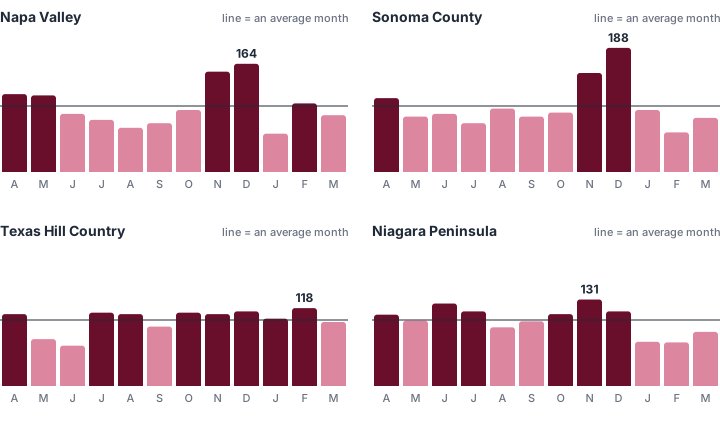
| Region (wineries, emails) | Apr | May | Jun | Jul | Aug | Sep | Oct | Nov | Dec | Jan | Feb | Mar |
|---|---|---|---|---|---|---|---|---|---|---|---|---|
| Napa Valley (14, 806) | 118 | 116 | 88 | 79 | 67 | 74 | 94 | 152 | 164 | 58 | 104 | 86 |
| Sonoma County (15, 601) | 112 | 84 | 88 | 74 | 96 | 84 | 90 | 150 | 188 | 94 | 60 | 82 |
| California, other (35, 1,718) | 97 | 113 | 76 | 78 | 78 | 69 | 104 | 156 | 170 | 68 | 81 | 109 |
| Oregon (9, 436) | 85 | 116 | 85 | 77 | 88 | 74 | 118 | 138 | 160 | 69 | 88 | 102 |
| Walla Walla Valley (11, 556) | 117 | 121 | 97 | 82 | 91 | 71 | 123 | 138 | 132 | 63 | 78 | 88 |
| Niagara Peninsula (17, 713) | 108 | 99 | 125 | 113 | 89 | 98 | 109 | 131 | 113 | 67 | 66 | 82 |
| Texas Hill Country (19, 508) | 109 | 71 | 61 | 111 | 109 | 90 | 111 | 109 | 113 | 102 | 118 | 97 |
| Okanagan Valley (10, 165) | 102 | 124 | 116 | 44 | 131 | 73 | 131 | 124 | 109 | 58 | 102 | 87 |
“California, other” and “Oregon” are wineries in those states that we haven’t yet placed in a specific wine region. Regions where we followed fewer than 7 wineries for the full year aren’t shown.
Napa, Sonoma, California and Oregon
These four have the classic shape: a spring lift, a slow summer, and a strong finish. November and December run from 138 to 188. January falls to between 58 and 94. Napa’s summer is the quietest of any region here, with August at 67.
Texas Hill Country
This is the flattest line in the table. November is 109 and December 113, so there is very little holiday peak. February, at 118, is the busiest month of its year. The dip comes in May and June (71 and 61) instead of late summer.
Niagara Peninsula
Niagara has two peaks: June and July (125 and 113), then November (131). December is only 113. January and February are its quietest months, at 67 and 66.
Walla Walla Valley
Walla Walla lifts in April and May (117 and 121) and again from October to December (123 to 138), without the December spike California shows.
Okanagan Valley
The Okanagan row is from 10 wineries and 165 emails, the smallest sample in the table, and it jumps around: 44 in July, 131 in August. Read it as a rough sketch.
Why would regions differ this much?
The archive shows the pattern, not the cause, so anything here is a guess. One possibility is that the calendar follows how a region sells: a winery that ships gifts nationally has a December to mail for, and a winery that sells mostly to visitors mails around its own visiting season. We haven’t tested that. When wineries send holiday emails looks at the gift season week by week.
How do you use this?
Find your region in the table and compare its shape with your own sends over the last 12 months. Count your emails by month, divide each month by your monthly average and multiply by 100. That gives you your own index to put beside your region’s.
Two things are worth looking for. First, months where your region is busy and you were quiet, or the reverse. Second, whether the all-region line is even the right comparison for you. A Hill Country winery planning around a national December peak is planning around a peak its neighbours don’t have.
FAQ
What is the busiest month for winery email?
December, across the wineries Joy Cork follows: 47% above an average month from April 2025 to March 2026, among 207 wineries. November is next, at 35% above.
What is the slowest month for winery email?
January, at 26% below an average month. September is the quietest month of the summer and fall, at 17% below.
Do all wine regions have a holiday email peak?
No. Napa, Sonoma, the rest of California and Oregon do, with November and December 38% to 88% above average. Texas Hill Country shows almost none, at 9% to 13% above.
How many wineries are these regional figures based on?
Between 9 and 35 per region, counting only wineries followed for the full 12 months. The sample for each region is shown in the table.
A note on these figures: they are counts from the Joy Cork archive as of October 10, 2026, for April 2025 to March 2026. Each index compares a month with that region’s own monthly average, using only wineries followed for the whole period. Regional samples are small (9 to 35 wineries), so a few wineries changing their habits would move a row. The archive records what was sent, not how it performed.
Written by Bill Eisenhauer at Joy Cork.

Bill Eisenhauer
Joy Cork keeps a growing archive of real winery marketing emails, so wineries and agencies can see what others send. This article is also available as Markdown.
Want to see what wineries like yours are sending?
Joy Cork is invitation-only for now. Request access and we'll reply within one working day.
Request received
Joy Cork is invitation-only for now. We review each request and reply by email within one working day.
Tell us about your winery or agency →Request received
is on our access list.
Joy Cork is invitation-only for now. We review each request and reply by email within one working day.
Invitation-only for now. We reply within one working day.