<?xml version="1.0" encoding="utf-8"?><feed xmlns="http://www.w3.org/2005/Atom" ><generator uri="https://jekyllrb.com/" version="4.4.1">Jekyll</generator><link href="https://joycork.com/feed.xml" rel="self" type="application/atom+xml" /><link href="https://joycork.com/" rel="alternate" type="text/html" /><updated>2026-10-11T04:39:29+00:00</updated><id>https://joycork.com/feed.xml</id><title type="html">Joy Cork</title><subtitle>Joy Cork is a growing archive of real winery marketing emails. Wineries and agencies use it to see what peers send, how often, through which email platform, and with which offers, events and wines.</subtitle><author><name>Bill Eisenhauer</name></author><entry><title type="html">What Subscribing to a Winery’s Emails Is Like, From the Subscriber’s Side</title><link href="https://joycork.com/articles/what-subscribing-to-a-winerys-emails-is-like/" rel="alternate" type="text/html" title="What Subscribing to a Winery’s Emails Is Like, From the Subscriber’s Side" /><published>2026-10-06T00:00:00+00:00</published><updated>2026-10-10T00:00:00+00:00</updated><id>https://joycork.com/articles/what-subscribing-to-a-winerys-emails-is-like</id><content type="html" xml:base="https://joycork.com/articles/what-subscribing-to-a-winerys-emails-is-like/"><![CDATA[<p>Joy Cork’s archive exists because we subscribe to winery mailing lists the way a customer would. So we see the signup from the outside. In one recent run, we tried to join 38 winery lists by hand, in a browser. Thirteen let us in with a single step. Eleven had no public signup to find.</p>

<h2 id="at-a-glance">At a glance</h2>

<ul>
  <li><strong>13 of 38 signups took one step.</strong> Enter an address, submit, done.</li>
  <li><strong>11 of 38 had no public email signup.</strong> The only way onto the list was a club membership, a shop account, or nothing.</li>
  <li><strong>12 of 38 needed a person to push through something:</strong> a bot check, extra required fields, or creating an account.</li>
  <li><strong>A welcome email is common but not universal.</strong> At least 48% of the wineries we follow have sent one.</li>
</ul>

<h2 id="what-happened-when-we-tried-to-subscribe">What happened when we tried to subscribe?</h2>

<figure class="not-prose my-10">
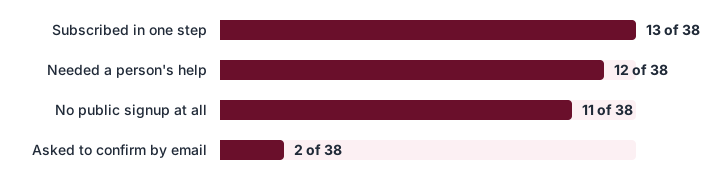
  <img src="/assets/images/figures/signup-outcomes.svg" alt="Bar chart of 38 signup attempts: 13 subscribed in one step, 12 needed a person&#39;s help, 11 had no public signup, 2 asked to confirm by email." loading="lazy" class="w-full h-auto" />
  <figcaption class="text-sm text-gray-500 mt-3">Outcomes of signing up to 38 winery mailing lists by hand on October 10, 2026. One run, not a survey.</figcaption>
</figure>

<p>On October 10, 2026 we worked through 38 wineries whose mail had stopped arriving, and signed up again on each winery’s own website.</p>

<table>
  <thead>
    <tr>
      <th>Outcome</th>
      <th>Wineries</th>
    </tr>
  </thead>
  <tbody>
    <tr>
      <td>Subscribed in one step</td>
      <td>13</td>
    </tr>
    <tr>
      <td>Subscribed, then asked to confirm by email</td>
      <td>2</td>
    </tr>
    <tr>
      <td>Needed a person to get past an obstacle</td>
      <td>12</td>
    </tr>
    <tr>
      <td>No public signup at all</td>
      <td>11</td>
    </tr>
  </tbody>
</table>

<p>One of the 13 is a “probably”: the form accepted the address and said nothing, which is its own small problem for a subscriber.</p>

<p>This is one run on 38 wineries, and they were wineries whose mail to us had lapsed, so it isn’t a survey of the industry. It is a fair picture of what an ordinary visitor meets, because that is all we were.</p>

<h2 id="what-got-in-the-way">What got in the way?</h2>

<p>For the 12 that needed a person, these were the obstacles. A winery can appear in more than one row.</p>

<table>
  <thead>
    <tr>
      <th>Obstacle</th>
      <th>Wineries</th>
    </tr>
  </thead>
  <tbody>
    <tr>
      <td>A CAPTCHA or bot check</td>
      <td>4</td>
    </tr>
    <tr>
      <td>A required birth date, phone number or state</td>
      <td>4</td>
    </tr>
    <tr>
      <td>Having to create an account first</td>
      <td>3</td>
    </tr>
    <tr>
      <td>Only a general contact form</td>
      <td>2</td>
    </tr>
    <tr>
      <td>The form returned an error</td>
      <td>1</td>
    </tr>
  </tbody>
</table>

<p>None of these is unreasonable alone. A birth date is an age check. A bot check keeps junk off the list. An account ties the subscriber to the shop. But each is a moment where a person who wanted the emails can decide not to bother, and a subscriber meets them one after another without knowing why they are there.</p>

<h2 id="what-about-the-11-with-no-signup">What about the 11 with no signup?</h2>

<p>They had a wine club to join or a shop account to create, and no way to simply ask for the emails. For a winery that sells mostly to members, that may be a deliberate choice. It does mean that a visitor who isn’t ready to join has no smaller step to take.</p>

<h2 id="what-arrives-after-you-subscribe">What arrives after you subscribe?</h2>

<p>Often a welcome. Of the 284 wineries in the archive, 135 have a welcome email there, or 48%. Treat that as a floor, not a rate: the archive only holds a welcome if we signed up while it was collecting, so some wineries that do send one aren’t counted.</p>

<p>After the welcome, the first regular campaign follows quickly. Across 228 welcome emails, the next ordinary marketing email arrived a median of 5.5 days later, and within 2.3 to 16.9 days for the middle half. That fits <a href="/articles/how-often-do-wineries-email-their-lists/">how often wineries send</a> in general: at one email every 12 days or so, a new subscriber doesn’t wait long.</p>

<p>We can’t yet say how long it takes from pressing “subscribe” to the first email of any kind. We only began recording signup dates with this run.</p>

<h2 id="how-do-you-check-your-own-signup">How do you check your own signup?</h2>

<p>It takes ten minutes, and it is worth doing on a phone, in a private window, with an address you haven’t used before.</p>

<ol>
  <li>Start on your home page and find the signup without using the site search. Note how many taps it took.</li>
  <li>Fill it in. Count the required fields, and ask of each whether a newsletter needs it.</li>
  <li>Submit, and read what the page says next. If it says nothing, that is what your subscribers see.</li>
  <li>Check the inbox. Note whether a confirmation arrives, whether a welcome arrives, and how long the first regular email takes.</li>
</ol>

<p>Write the answers down. Nobody on your team sees this path in a normal week, because everybody on your team is already on the list.</p>

<h2 id="faq">FAQ</h2>

<h3 id="how-many-steps-does-it-take-to-subscribe-to-a-winerys-email-list">How many steps does it take to subscribe to a winery’s email list?</h3>

<p>In our run of 38 wineries, 13 took a single step and 2 more added a confirmation email. Twelve needed extra effort, and 11 had no public signup.</p>

<h3 id="do-wineries-use-double-opt-in">Do wineries use double opt-in?</h3>

<p>Some do. Two of the 38 signups in our October 2026 run asked us to confirm by email before the subscription started.</p>

<h3 id="do-wineries-send-a-welcome-email">Do wineries send a welcome email?</h3>

<p>At least 48% of the wineries in the Joy Cork archive have sent one (135 of 284). The real share is higher, because the archive only catches welcomes for signups made while it was collecting.</p>

<h3 id="how-soon-after-the-welcome-email-does-the-first-campaign-arrive">How soon after the welcome email does the first campaign arrive?</h3>

<p>A median of 5.5 days, from 228 welcome emails in the archive. The middle half fell between 2.3 and 16.9 days.</p>

<hr />

<p><em>A note on these figures: the signup counts come from one run on October 10, 2026, covering 38 wineries whose mail to Joy Cork had lapsed. They describe that run, not all wineries, and we name none of them. Welcome-email figures come from the full archive of 284 wineries as of the same date.</em></p>

<p><em>Written by Bill Eisenhauer at <a href="/">Joy Cork</a>.</em></p>]]></content><author><name>Bill Eisenhauer</name></author><summary type="html"><![CDATA[We tried to sign up for 38 winery mailing lists in a browser, by hand. 13 took one step. 11 had no public signup at all. Here is what stood between a willing subscriber and the list.]]></summary><media:thumbnail xmlns:media="http://search.yahoo.com/mrss/" url="https://joycork.com/assets/images/cards/what-subscribing-to-a-winerys-emails-is-like.jpg" /><media:content medium="image" url="https://joycork.com/assets/images/cards/what-subscribing-to-a-winerys-emails-is-like.jpg" xmlns:media="http://search.yahoo.com/mrss/" /></entry><entry><title type="html">How Often Do Wineries Email Their Lists?</title><link href="https://joycork.com/articles/how-often-do-wineries-email-their-lists/" rel="alternate" type="text/html" title="How Often Do Wineries Email Their Lists?" /><published>2026-09-29T00:00:00+00:00</published><updated>2026-10-10T00:00:00+00:00</updated><id>https://joycork.com/articles/how-often-do-wineries-email-their-lists</id><content type="html" xml:base="https://joycork.com/articles/how-often-do-wineries-email-their-lists/"><![CDATA[<p>The median winery in the Joy Cork archive sent 31 marketing emails in the 12 months to September 30, 2026. That works out to roughly one every 12 days. The middle half of wineries sent between 15 and 58, and the full range runs from 2 emails to 216.</p>

<h2 id="at-a-glance">At a glance</h2>

<ul>
  <li><strong>31 a year is the middle.</strong> Half of the 215 wineries we followed all year sent more than that, half sent fewer.</li>
  <li><strong>15 to 58 covers the middle half.</strong> That is the difference between a little more than one email a month and a little more than one a week.</li>
  <li><strong>Tuesday and Thursday are the busiest days.</strong> Together they carry 39% of sends.</li>
  <li><strong>Mornings carry more than half.</strong> 52% of emails go out between 6am and noon, winery local time.</li>
</ul>

<h2 id="how-many-emails-does-a-winery-send-in-a-year">How many emails does a winery send in a year?</h2>

<p>We counted marketing emails from 215 wineries between October 1, 2025 and September 30, 2026. To be counted, a winery had to have mail in the archive both before January 2026 and after July 2026, so each one was followed for the whole year.</p>

<table>
  <thead>
    <tr>
      <th>Measure</th>
      <th>Emails in 12 months</th>
    </tr>
  </thead>
  <tbody>
    <tr>
      <td>Lowest</td>
      <td>2</td>
    </tr>
    <tr>
      <td>Lower quartile</td>
      <td>15</td>
    </tr>
    <tr>
      <td>Median</td>
      <td>31</td>
    </tr>
    <tr>
      <td>Upper quartile</td>
      <td>58</td>
    </tr>
    <tr>
      <td>Highest</td>
      <td>216</td>
    </tr>
  </tbody>
</table>

<p>The spread matters more than the median. A winery sending 15 emails a year and one sending 58 are both ordinary. They are just running different programs.</p>

<h2 id="does-cadence-differ-by-state">Does cadence differ by state?</h2>

<p>Somewhat. These are the states and provinces where we followed at least 8 wineries all year.</p>

<table>
  <thead>
    <tr>
      <th>State or province</th>
      <th>Wineries</th>
      <th>Median</th>
      <th>Middle half</th>
    </tr>
  </thead>
  <tbody>
    <tr>
      <td>Ontario</td>
      <td>19</td>
      <td>43</td>
      <td>21–64</td>
    </tr>
    <tr>
      <td>California</td>
      <td>76</td>
      <td>41</td>
      <td>21–64</td>
    </tr>
    <tr>
      <td>Washington</td>
      <td>14</td>
      <td>41</td>
      <td>15–88</td>
    </tr>
    <tr>
      <td>Oregon</td>
      <td>14</td>
      <td>31</td>
      <td>18–68</td>
    </tr>
    <tr>
      <td>Texas</td>
      <td>22</td>
      <td>23</td>
      <td>13–48</td>
    </tr>
    <tr>
      <td>New York</td>
      <td>12</td>
      <td>21</td>
      <td>19–31</td>
    </tr>
    <tr>
      <td>British Columbia</td>
      <td>10</td>
      <td>15</td>
      <td>13–23</td>
    </tr>
  </tbody>
</table>

<p>California, Ontario and Washington wineries send about 40 emails a year at the median. Texas and New York send about half that, and British Columbia fewer still. The ranges overlap heavily, though. A Texas winery in the top quarter of its state sends more than the median California winery.</p>

<p>Outside California the samples are small, so read each row as “the wineries we follow there”, not as a verdict on the state.</p>

<h2 id="which-day-of-the-week-do-wineries-send">Which day of the week do wineries send?</h2>

<figure class="not-prose my-10">
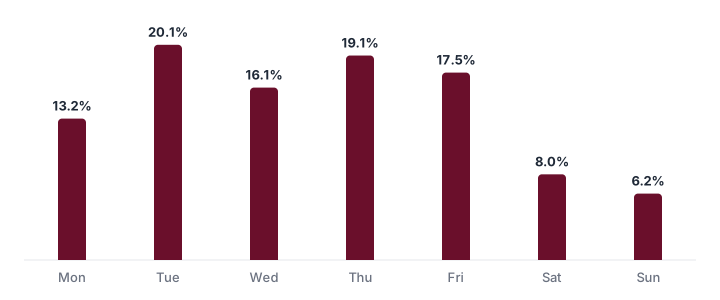
  <img src="/assets/images/figures/send-weekday.svg" alt="Column chart of sends by weekday: Tuesday 20.1%, Thursday 19.1%, Friday 17.5%, Wednesday 16.1%, Monday 13.2%, Saturday 8.0%, Sunday 6.2%." loading="lazy" class="w-full h-auto" />
  <figcaption class="text-sm text-gray-500 mt-3">Share of 9,085 winery emails by day of the week, winery local time, October 2025 to September 2026.</figcaption>
</figure>

<table>
  <thead>
    <tr>
      <th>Day</th>
      <th>Share of sends</th>
    </tr>
  </thead>
  <tbody>
    <tr>
      <td>Tuesday</td>
      <td>20.1%</td>
    </tr>
    <tr>
      <td>Thursday</td>
      <td>19.1%</td>
    </tr>
    <tr>
      <td>Friday</td>
      <td>17.5%</td>
    </tr>
    <tr>
      <td>Wednesday</td>
      <td>16.1%</td>
    </tr>
    <tr>
      <td>Monday</td>
      <td>13.2%</td>
    </tr>
    <tr>
      <td>Saturday</td>
      <td>8.0%</td>
    </tr>
    <tr>
      <td>Sunday</td>
      <td>6.2%</td>
    </tr>
  </tbody>
</table>

<p>This is from 9,085 emails in the same 12 months, with the day worked out in the winery’s own time zone, which we approximate from its state.</p>

<p>Weekdays carry 86% of sends. Friday is the third-busiest day. More than a quarter of the archive is event email, much of it about the coming weekend, which may be part of why.</p>

<h2 id="what-time-of-day-do-wineries-send">What time of day do wineries send?</h2>

<ul>
  <li>The 9am and 10am hours together carry 29% of sends. The single busiest hour is 10am to 11am, at 16.8%.</li>
  <li>6am to noon carries 52%.</li>
  <li>Noon to 5pm carries 31%.</li>
  <li>After 6pm carries 10%.</li>
</ul>

<p>These are the times wineries choose. The archive has no open data, so it can’t say which hour gets read.</p>

<h2 id="is-there-a-right-frequency">Is there a “right” frequency?</h2>

<p>Not one the archive can give you. It shows what wineries do, and what they do varies about fourfold inside the ordinary range. The more useful comparison is with wineries like yours, which is also why the season matters: a winery’s cadence in the weeks before Thanksgiving looks nothing like its cadence in January.</p>

<p>To place your own program, count the marketing emails you sent in the last 12 months and see where the number falls in the first table. Then count them by month. An even 3 a month and a pattern of 1 a month with 12 in December are both “36 a year”, and they are not the same program.</p>

<h2 id="faq">FAQ</h2>

<h3 id="how-often-should-a-winery-send-marketing-emails">How often should a winery send marketing emails?</h3>

<p>The archive can only say how often wineries do. The median is 31 emails in 12 months, with the middle half between 15 and 58, among 215 wineries followed from October 2025 to September 2026.</p>

<h3 id="what-is-the-most-common-day-for-wineries-to-send-email">What is the most common day for wineries to send email?</h3>

<p>Tuesday, with 20.1% of sends, followed by Thursday at 19.1% and Friday at 17.5%.</p>

<h3 id="what-time-do-wineries-send-their-emails">What time do wineries send their emails?</h3>

<p>Mostly in the morning. 52% of sends go out between 6am and noon in the winery’s local time, and the busiest single hour is 10am to 11am.</p>

<h3 id="do-california-wineries-email-more-than-texas-wineries">Do California wineries email more than Texas wineries?</h3>

<p>At the median, yes: 41 emails a year against 23, among the wineries Joy Cork follows. The ranges overlap, so plenty of Texas wineries send more than a typical California one.</p>

<hr />

<p><em>A note on these figures: they are counts from the Joy Cork archive as of October 10, 2026. Cadence covers 215 wineries followed for the full 12 months to September 30, 2026. Weekday and hour figures cover 9,085 emails in that window, in local time approximated from each winery’s state. The archive holds what wineries sent, not how the emails performed.</em></p>

<p><em>Written by Bill Eisenhauer at <a href="/">Joy Cork</a>.</em></p>]]></content><author><name>Bill Eisenhauer</name></author><summary type="html"><![CDATA[The median winery in the Joy Cork archive sent 31 marketing emails in the last 12 months, about one every 12 days. The middle half sent between 15 and 58. Here is how that varies by state, weekday and hour.]]></summary><media:thumbnail xmlns:media="http://search.yahoo.com/mrss/" url="https://joycork.com/assets/images/cards/how-often-do-wineries-email-their-lists.jpg" /><media:content medium="image" url="https://joycork.com/assets/images/cards/how-often-do-wineries-email-their-lists.jpg" xmlns:media="http://search.yahoo.com/mrss/" /></entry><entry><title type="html">Which Email Platforms Do Wineries Use?</title><link href="https://joycork.com/articles/which-email-platforms-do-wineries-use/" rel="alternate" type="text/html" title="Which Email Platforms Do Wineries Use?" /><published>2026-09-22T00:00:00+00:00</published><updated>2026-10-10T00:00:00+00:00</updated><id>https://joycork.com/articles/which-email-platforms-do-wineries-use</id><content type="html" xml:base="https://joycork.com/articles/which-email-platforms-do-wineries-use/"><![CDATA[<p>Two services send most winery email. Of the 277 wineries in the Joy Cork archive whose sending service we can identify, 98 sent with Klaviyo and 98 with Mailchimp in their most recent 90 days of mail. That is 35% each. No other service reaches 7%.</p>

<h2 id="at-a-glance">At a glance</h2>

<ul>
  <li><strong>35% and 35%.</strong> Klaviyo and Mailchimp are level at 98 wineries each, out of 277.</li>
  <li><strong>California leans Klaviyo, most other places lean Mailchimp.</strong> 58 of 97 California wineries send with Klaviyo. In Texas, Oregon, Washington, New York and British Columbia, Mailchimp is the most common.</li>
  <li><strong>39 wineries switched while we followed them,</strong> and 29 of those moved to Klaviyo.</li>
  <li><strong>This is a count of who sends with what.</strong> It says nothing about which service is better.</li>
</ul>

<h2 id="which-services-send-winery-email">Which services send winery email?</h2>

<figure class="not-prose my-10">
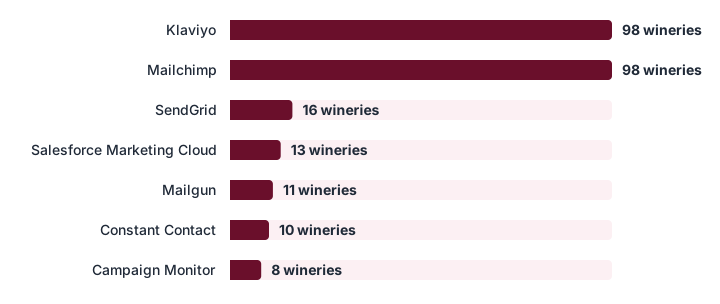
  <img src="/assets/images/figures/platform-share.svg" alt="Bar chart: Klaviyo and Mailchimp each send for 98 wineries; SendGrid 16, Salesforce Marketing Cloud 13, Mailgun 11, Constant Contact 10, Campaign Monitor 8." loading="lazy" class="w-full h-auto" />
  <figcaption class="text-sm text-gray-500 mt-3">Wineries by the service they sent with in their last 90 days of mail, of 277 with an identified service. Joy Cork archive, October 10, 2026.</figcaption>
</figure>

<table>
  <thead>
    <tr>
      <th>Service</th>
      <th>Wineries</th>
      <th>Share of 277</th>
    </tr>
  </thead>
  <tbody>
    <tr>
      <td>Klaviyo</td>
      <td>98</td>
      <td>35%</td>
    </tr>
    <tr>
      <td>Mailchimp</td>
      <td>98</td>
      <td>35%</td>
    </tr>
    <tr>
      <td>SendGrid</td>
      <td>16</td>
      <td>6%</td>
    </tr>
    <tr>
      <td>Salesforce Marketing Cloud</td>
      <td>13</td>
      <td>5%</td>
    </tr>
    <tr>
      <td>Mailgun</td>
      <td>11</td>
      <td>4%</td>
    </tr>
    <tr>
      <td>Constant Contact</td>
      <td>10</td>
      <td>4%</td>
    </tr>
    <tr>
      <td>Campaign Monitor</td>
      <td>8</td>
      <td>3%</td>
    </tr>
  </tbody>
</table>

<p>Everything else is 5 wineries or fewer: SparkPost, Commerce7, Squarespace Email, Amazon SES, Flodesk, HubSpot, WineDirect, Wix, ActiveCampaign, Brevo, Shopify Email, MailerLite and Emma. Eleven wineries currently send through two services, so the rows add up to slightly more than 277.</p>

<p>One caution about the middle of the table. SendGrid, Mailgun, SparkPost and Amazon SES are sending infrastructure. A winery rarely picks one of them directly. More often its commerce or club platform sends through one on the winery’s behalf. Read those rows as “the service that delivered the email”, not “the tool the marketing team logs into”.</p>

<h2 id="does-the-platform-differ-by-region">Does the platform differ by region?</h2>

<p>It does. These are the most common services by state or province, among wineries with an identified service.</p>

<table>
  <thead>
    <tr>
      <th>State or province</th>
      <th>Wineries</th>
      <th>Most common services</th>
    </tr>
  </thead>
  <tbody>
    <tr>
      <td>California</td>
      <td>97</td>
      <td>Klaviyo 58, Mailchimp 23, SparkPost 4, SendGrid 4</td>
    </tr>
    <tr>
      <td>Texas</td>
      <td>33</td>
      <td>Mailchimp 15, Klaviyo 6, SendGrid 4, Mailgun 2</td>
    </tr>
    <tr>
      <td>Ontario</td>
      <td>24</td>
      <td>Mailchimp 9, Salesforce Marketing Cloud 8, Klaviyo 4, Mailgun 2</td>
    </tr>
    <tr>
      <td>Oregon</td>
      <td>20</td>
      <td>Mailchimp 11, Klaviyo 6</td>
    </tr>
    <tr>
      <td>Washington</td>
      <td>19</td>
      <td>Mailchimp 7, Klaviyo 5, Campaign Monitor 4</td>
    </tr>
    <tr>
      <td>New York</td>
      <td>15</td>
      <td>Mailchimp 7, Klaviyo 2</td>
    </tr>
    <tr>
      <td>British Columbia</td>
      <td>11</td>
      <td>Mailchimp 6, ActiveCampaign 2</td>
    </tr>
  </tbody>
</table>

<p>California is the outlier. Six in ten of its wineries send with Klaviyo, and California is also where 58 of the archive’s 98 Klaviyo senders are. Ontario is the one place where Salesforce Marketing Cloud is common, at 8 of 24 wineries.</p>

<p>The samples outside California are small. A handful of wineries changing service would reorder any of those rows, so treat them as a description of the wineries we follow rather than of the whole state.</p>

<h2 id="are-wineries-switching-platforms">Are wineries switching platforms?</h2>

<p>Yes, and more each year. Thirty-nine wineries made a clean move from one service to another while we were subscribed to them: 3 in 2024, 15 in 2025 and 21 in 2026 through September. Part of that rise is simply that we follow more wineries now than we did in 2024.</p>

<p>Where they went:</p>

<table>
  <thead>
    <tr>
      <th>Moved to</th>
      <th>Wineries</th>
    </tr>
  </thead>
  <tbody>
    <tr>
      <td>Klaviyo</td>
      <td>29</td>
    </tr>
    <tr>
      <td>Mailchimp</td>
      <td>6</td>
    </tr>
    <tr>
      <td>Mailgun</td>
      <td>2</td>
    </tr>
    <tr>
      <td>SendGrid</td>
      <td>1</td>
    </tr>
    <tr>
      <td>HubSpot</td>
      <td>1</td>
    </tr>
  </tbody>
</table>

<p>Where they came from: Mailchimp 13, Salesforce Marketing Cloud 11, Campaign Monitor 3, SendGrid 3, Constant Contact 2, Mailgun 2, and one each from five other services.</p>

<p>The single most common move was from Salesforce Marketing Cloud to Klaviyo. A Napa Valley winery made that move in spring 2026, for example, and others did the same in October 2025 and in June and July 2026.</p>

<h2 id="how-does-joy-cork-know-which-platform-sent-an-email">How does Joy Cork know which platform sent an email?</h2>

<p>From the email itself. Every marketing email carries technical headers and link domains that belong to the service that sent it. Joy Cork reads those for each email it receives, which is also how it notices when a winery’s mail starts arriving from somewhere new.</p>

<p>We could not identify the service for 7 of the 284 wineries in the archive, which is why the figures above are out of 277.</p>

<h2 id="what-can-you-do-with-this">What can you do with this?</h2>

<p>If you are weighing a platform change, the useful question is narrower than “what does everyone use”. Look at wineries like yours: your region, your size, your mix of club and shop. Then look at what their emails are built from after a move, not only at the name of the service. Two wineries on the same platform can send very different mail.</p>

<h2 id="faq">FAQ</h2>

<h3 id="what-email-platform-do-most-wineries-use">What email platform do most wineries use?</h3>

<p>In the Joy Cork archive, Klaviyo and Mailchimp are tied. Each sent for 98 of the 277 wineries with an identified sending service, or 35%, as of October 10, 2026.</p>

<h3 id="is-klaviyo-or-mailchimp-better-for-a-winery">Is Klaviyo or Mailchimp better for a winery?</h3>

<p>The archive can’t answer that. It records which service sent each email. It has no open, click or sales data, so it can’t compare results.</p>

<h3 id="do-wineries-use-commerce7-or-winedirect-to-send-email">Do wineries use Commerce7 or WineDirect to send email?</h3>

<p>A few do: each sends for 5 or fewer of the wineries we follow. Some winery-commerce platforms also send through infrastructure services such as SendGrid or Mailgun, which show up under those names in our counts.</p>

<h3 id="how-often-do-wineries-change-email-platforms">How often do wineries change email platforms?</h3>

<p>Among the wineries Joy Cork follows, 39 changed service between 2024 and September 2026, and 29 of them moved to Klaviyo.</p>

<hr />

<p><em>A note on these figures: they are counts from the Joy Cork archive as of October 10, 2026, covering 284 wineries in the United States, Canada and Australia that we subscribe to. The service is the one each winery sent with in its most recent 90 days of mail. The archive is a sample of wineries with public mailing lists, weighted toward California, Texas and Ontario, not a census of the industry.</em></p>

<p><em>Written by Bill Eisenhauer at <a href="/">Joy Cork</a>.</em></p>]]></content><author><name>Bill Eisenhauer</name></author><summary type="html"><![CDATA[Klaviyo and Mailchimp each send for 35% of the 277 wineries in the Joy Cork archive with an identified sending service. Here is the full split, how it differs by state, and where wineries are moving.]]></summary><media:thumbnail xmlns:media="http://search.yahoo.com/mrss/" url="https://joycork.com/assets/images/cards/which-email-platforms-do-wineries-use.jpg" /><media:content medium="image" url="https://joycork.com/assets/images/cards/which-email-platforms-do-wineries-use.jpg" xmlns:media="http://search.yahoo.com/mrss/" /></entry></feed>